CSU as a competitive Center of RDE excellence significantly contributing to the improved quality of life of urban and rural communities in the Cagayan Valley Region.
To intensively pursue the generation, development, sharing, utilization and application of science-based knowledge, information and innovations for the inclusive agro-industrial development and climate change resiliency of the Cagayan Valley Region.
Goal 1. To explore science-based and innovative solutions that will result in real impacts to
Goal 2. To address pressing needs of communities for resilience through indigenous and science-based knowledge and technologies;
Goal 3. To engage, capacitate and increase access to appropriate knowledge and technologies for sustainable and secure livelihood and wellbeing of communities; and
Goal 4. To upgrade manpower facilities for resilience.
To achieve the above goals, it shall pursue the following objectives:
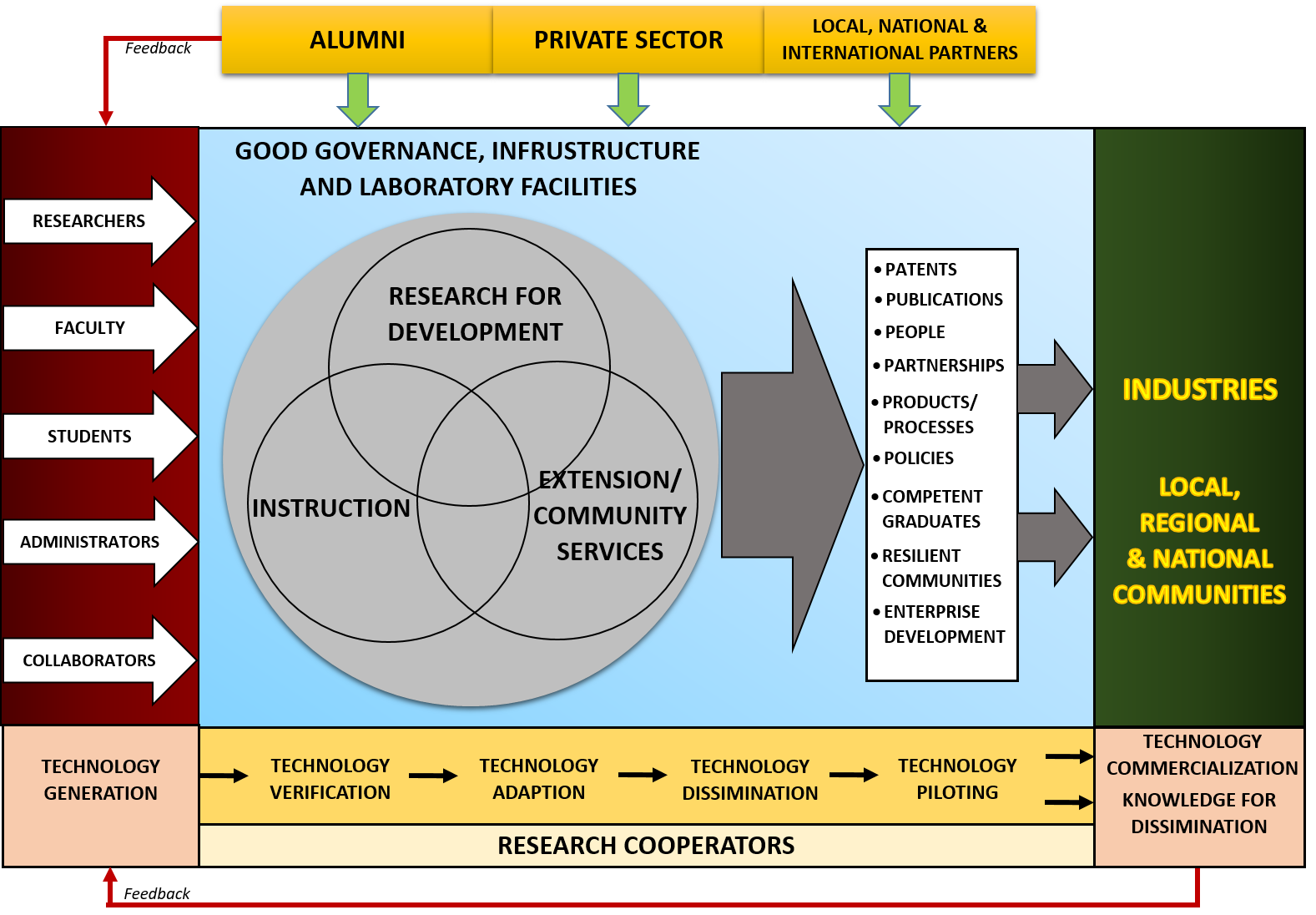
The RDE Framework is based on the Instruction, Research and Development and Extension Interface. It is propelled by the technology development process from Technology Generation (TG), Technology Verification (TV), Technology Adaptation (TA), Technology Dissemination (TD), Technology Piloting (TP), to Knowledge for Dissemination (KD) and Technology Commercialization (TC). The generators of technology are the researchers, faculty, students, administrators and research collaborators. TV, TA, TD and TP are conducted at the farmers’ level through research cooperators while KD and TC are done at local, regional and national level with industries and communities as adopters.
The Instruction, Research, and Extension mission of the university is equipped with physical infrastructure and laboratory facilities managed by good governance to produce competent graduates, resilient communities, and the 6Ps as deliverables of RDE as well as enterprise development as offshoot of production.
Financial and technical support from alumni, private sector, and from local and international partners would greatly contribute to the intensification of technology development within the university.
Likewise, feedbacking is encouraged for the improvement and advancement of technology innovation undertakings in the university.
As the CSU gears up to strengthen its capability in RDE, it needs to embrace and pursue a new RDE paradigm. The Sustainable Development Goals (SDGs) have broadened development outcomes from merely increasing food supply to include poverty reduction, human nutrition, environmental protection and related issues. Similarly, AmBisyon Natin 2040 is the anchor of the country’s plans. It envisions Filipinos to enjoy a strongly rooted, comfortable, and secured life. As a consequence, RDE at CSU must be linked with the country’s vision and Cagayan’s development goals to gain more relevance and have significant impact.
The emergence of global markets and new technologies, particularly ICT and biotechnology has facilitated a paradigmatic shift in RDE. Towards this, public institutions like SUCs have adapted to the contemporary setting by redefining their priorities, changing their focus towards the poor and marginalized sectors of society.
More specifically, RDE are seeing the emergence of new capabilities, organizations, and institutional processes where partnerships are increasingly becoming important. As a result, the process of networking, establishing strategic alliances and coalition building have become very important.
In the foregoing context, R4D implements RDE programs and projects that has (1) developmental relevance, (2) links RDE with those who can use it; and (3) deploys a variety of approaches and strategies to ensure that the results of its RDE work is used and incorporated into development processes.
CSU should depart from the traditional research and development (R&D) approach and shift to a research for development (R4D) paradigm. R4D links research outputs with development outcomes (e.g., poverty reduction, environmental protection, people empowerment) and priority RDE agenda is formulated with stakeholder engagement. Likewise, RDE thrusts should be based on market demand and inclusive, people oriented development (IPOD) approaches, and conduct Research for Development (R4D).
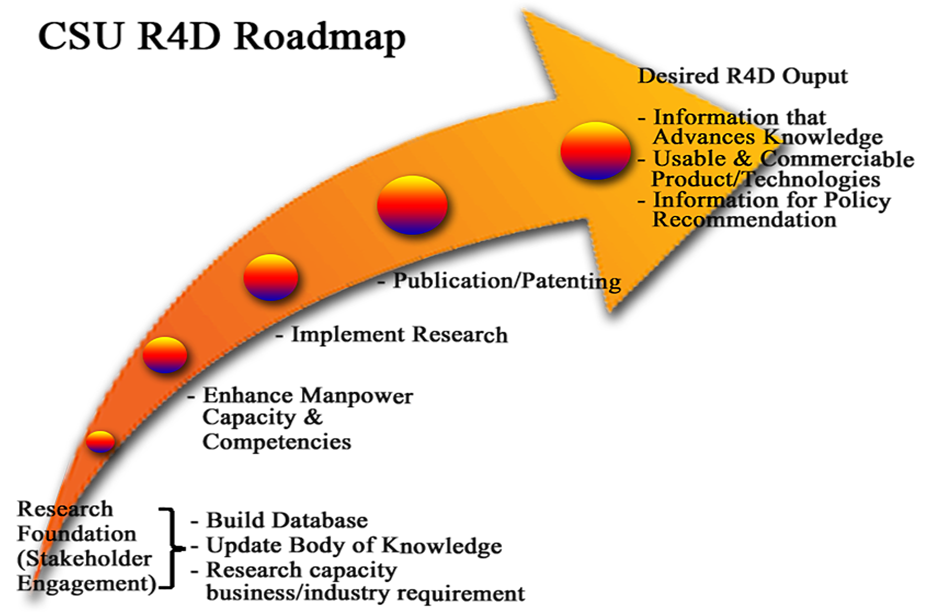
To ensure research relevance, CSU should efficiently produce the expected outputs of research in a focused and coordinated manner, to wit: a) information that advances knowledge; b) usable and commerciable technologies; and c) policy recommendations with majority of the outputs being usable technologies. Figure below shows the CSU R4D Roadmap commencing from Research Foundation to accomplishing its desired output.